
ISO 27001 Certification Cost: What You’ll Actually Pay For
The cost of ISO 27001 certification can range from several thousand dollars for a relatively small, straightforward organization to tens of thousands of dollars or more for a larger or more complex environment.
But asking “How much does ISO 27001 certification cost?” can be misleading because certification is only one part of the total investment.
Organizations may spend money on:
- certification body audit fees;
- gap assessments;
- consultants;
- security tools and control improvements;
- employee time;
- internal audit support;
- training;
- GRC or compliance software;
- remediation;
- ongoing surveillance and recertification.
Some of those costs are optional. Others depend heavily on what the organization already has in place.
A company with mature security processes, clear ownership, good evidence, and experienced internal staff may spend far less on implementation than an organization starting from scratch.
The more useful question is:
What will it cost our organization to build, operate, and certify an ISMS that meets our objectives?
This guide breaks that cost into the components you can actually plan for.
How Much Does ISO 27001 Certification Cost?
There is no universal ISO 27001 certification price.
Certification bodies determine audit time and pricing based on factors such as the size and complexity of the organization, the scope of the ISMS, the number of employees involved, locations, technologies, and other characteristics of the certification engagement.
That means two companies pursuing the same standard can receive very different quotes.
A small organization certifying a limited service may have a much smaller audit effort than a multinational organization placing multiple locations, business units, and complex infrastructure inside the ISMS scope.
The certification quote is also not the same thing as the total cost of ISO 27001.
A useful cost model separates the project into several categories.
| Cost Category | What It Covers |
|---|---|
| Certification | External certification audits and related certification activities |
| Implementation | Building the ISMS and required processes |
| Remediation | Closing security and management system gaps |
| Internal resources | Employee and leadership time |
| Advisory support | Consultants, specialists, or implementation assistance |
| Internal audit | Internal audit resources or external audit support |
| Technology | Security, evidence, workflow, or GRC tools |
| Ongoing maintenance | Operating and improving the ISMS after certification |
Some organizations will incur significant costs in nearly every category.
Others may already have most of the necessary capabilities.
Certification Cost vs. Implementation Cost
This distinction is essential when budgeting.
Certification cost is what you pay the certification body for the independent certification process.
Implementation cost is what you spend getting the organization and its ISMS ready for that process.
Imagine a certification body quotes $10,000 for the initial certification engagement.
That does not mean the organization’s ISO 27001 project costs $10,000.
If the organization also spends money on consulting, penetration testing, security improvements, employee training, internal audit support, new tooling, and hundreds of hours of employee time, the actual investment can be substantially higher.
On the other hand, a company with mature security practices may discover that much of what ISO 27001 requires is already happening.
Its primary work may involve organizing, formalizing, connecting, and improving existing processes rather than creating everything from zero.
That is why generic ISO 27001 price estimates should be treated cautiously.
The Main Costs of ISO 27001
Let’s look at the major areas that can affect the budget.
1. Certification Body Fees
If your organization wants accredited third-party certification, you’ll need to engage a certification body.
Initial certification generally involves a Stage 1 audit and a Stage 2 audit.
Stage 1 focuses on the ISMS and readiness for the more detailed assessment.
Stage 2 evaluates implementation and operation in greater depth.
The certification body may also charge for activities associated with the certification process, depending on its pricing model and the engagement.
After initial certification, the organization will have ongoing surveillance audits during the certification cycle and later a recertification audit.
So certification should not be budgeted as a one-time expense.
Think of it as a recurring cost associated with maintaining third-party certification.
2. ISO 27001 Implementation Support
Some organizations implement ISO 27001 almost entirely with internal resources.
Others hire consultants.
Consulting costs can vary dramatically depending on what you purchase.
One organization might need occasional advisory support.
Another might hire a consultant to help with:
- defining scope;
- performing a gap assessment;
- establishing the ISMS;
- developing the risk methodology;
- facilitating risk assessment;
- developing documentation;
- creating the Statement of Applicability;
- designing controls;
- preparing for internal audit;
- preparing for certification.
The more work you outsource, the higher the direct consulting cost is likely to be.
But the lowest consulting bill does not automatically mean the lowest total project cost.
If internal employees spend hundreds of hours trying to determine what to do, the organization is still paying for implementation through labor.
The cost simply appears somewhere else.
3. Employee Time
Employee time is one of the most overlooked ISO 27001 costs.
An ISMS cannot realistically be built and operated by one compliance person working in isolation.
The project may require involvement from:
- executive leadership;
- information security;
- IT;
- engineering;
- HR;
- legal;
- procurement;
- facilities;
- business owners;
- internal audit;
- risk owners.
Their time has a cost.
For example, someone may need to:
- participate in risk assessments;
- review policies;
- implement controls;
- gather evidence;
- attend interviews;
- remediate findings;
- complete access reviews;
- assess suppliers;
- review security metrics;
- participate in management review.
These activities may not generate invoices, but they consume organizational capacity.
A realistic ISO 27001 budget should account for them.
4. Gap Assessment
Before committing to a major implementation project, many organizations perform a gap assessment.
The goal is to determine what already exists, what needs improvement, and what is missing.
A useful gap assessment can reduce wasted effort.
For example, an organization might initially assume it needs dozens of new policies.
A proper assessment could reveal that the bigger problem is not documentation at all.
Perhaps existing policies are adequate, but:
- access reviews are inconsistent;
- supplier assessments aren’t performed;
- risk decisions aren’t documented;
- internal audits haven’t occurred;
- security metrics aren’t used;
- corrective actions aren’t tracked.
Understanding those gaps early helps direct money and effort toward the actual problems.
5. Security and Control Remediation
For some organizations, remediation becomes the largest cost.
ISO 27001 implementation may expose weaknesses that need to be addressed.
Examples could include:
- weak identity management;
- inadequate logging;
- unsupported systems;
- poor vulnerability management;
- missing backups;
- insufficient physical security;
- weak supplier management;
- inadequate endpoint protection;
- missing security awareness processes;
- immature incident response;
- inadequate secure development practices.
The cost of addressing these issues depends on what the organization discovers.
This is another reason certification cost alone is a poor proxy for total ISO 27001 cost.
The certification audit may be relatively inexpensive compared with fixing years of accumulated security weaknesses.
6. Internal Audit
Internal audit is part of the ISO 27001 management system.
Organizations need to plan how this function will be performed with appropriate objectivity and competence.
A larger organization may already have an internal audit function capable of supporting the process.
A smaller company may use another qualified internal resource or engage an external provider.
If external support is needed, it becomes another direct implementation and maintenance cost.
Internal audit should not be treated as a ceremonial pre-certification checklist.
A meaningful internal audit can identify problems before they become certification audit findings.
Our ISO 27001 Audit: What to Expect and How to Prepare guide explains the audit process in more detail.
7. Training
Training costs depend on what capabilities already exist internally.
Organizations may invest in training for:
- ISMS implementation;
- ISO 27001 requirements;
- internal auditing;
- risk management;
- control owners;
- security awareness;
- specialized technical responsibilities.
Not everyone needs expensive ISO certification training.
Training should match the person’s role.
A control owner responsible for quarterly access reviews needs to understand the organization’s process and their responsibilities.
They do not necessarily need to become an ISO 27001 lead auditor.
8. GRC and Compliance Software
ISO 27001 does not require a specialized GRC platform.
An organization can operate an ISMS using existing business systems, document repositories, ticketing platforms, spreadsheets, and other tools if those systems adequately support the process.
Dedicated software may still be useful.
Organizations might purchase tools to support:
- risk management;
- control tracking;
- evidence collection;
- policy management;
- audit management;
- corrective actions;
- compliance mapping;
- supplier risk;
- workflow automation.
Software can reduce administrative effort, especially as the ISMS grows.
But buying a GRC platform does not create an ISMS.
A poorly designed process remains poorly designed when moved into expensive software.
9. Documentation and Templates
Organizations need documented information to support the ISMS, but there are several ways to create it.
You can:
- build documentation internally;
- use templates;
- purchase an implementation toolkit;
- hire a consultant;
- combine those approaches.
Templates can significantly reduce the time spent starting from a blank page.
But they should be treated as implementation accelerators, not finished compliance artifacts.
A policy copied from a template but disconnected from actual organizational practice can create more problems than it solves.
The document needs to describe a process the organization can genuinely operate.
10. Certification Readiness and Remediation
Before certification, organizations often perform a final readiness review.
This can include:
- confirming the ISMS scope;
- reviewing the risk assessment;
- checking the Statement of Applicability;
- reviewing control implementation;
- sampling evidence;
- confirming internal audit completion;
- reviewing management review outputs;
- checking corrective actions;
- interviewing control owners.
The closer the ISMS gets to certification, the more expensive late discoveries can become.
Finding a major process gap several months before the audit gives the organization time to address it.
Finding it days before Stage 2 creates a very different situation.
What Determines the Cost of ISO 27001?
Several factors have an outsized effect on total cost.
Organization Size
Larger organizations generally have more employees, systems, departments, processes, and evidence to consider.
That can increase implementation and audit effort.
But employee count alone doesn’t determine complexity.
A small technology company operating a complex cloud platform can have a more complicated security environment than a much larger organization with relatively simple systems.
ISMS Scope
Scope is one of the most important cost drivers.
Compare:
Scope A: One cloud-based software service operated by one business unit.
Scope B: The entire global organization, multiple business units, several offices, development environments, corporate systems, and numerous services.
Those are very different certification projects.
Scope should be determined based on business objectives and legitimate organizational boundaries.
It should not be artificially narrowed simply to reduce audit costs.
But organizations also shouldn’t automatically put everything they own into the initial certification scope if that does not serve the business objective.
Number of Locations
Multiple physical locations can increase complexity.
Different offices may have different processes, physical security arrangements, personnel, technologies, and local requirements.
Existing Security Maturity
A mature organization may already have:
- risk management;
- documented security policies;
- identity management;
- incident response;
- vulnerability management;
- supplier security;
- internal audit;
- logging;
- security awareness;
- change management.
ISO 27001 implementation may primarily involve connecting and formalizing those activities within an ISMS.
An immature organization may need to build many of them from scratch.
That difference can dramatically affect cost.
Internal Expertise
An organization with employees who understand ISO 27001, security governance, risk management, controls, and auditing may require less external assistance.
Without that expertise, outside support may save significant time and reduce implementation mistakes.
Certification Timeline
Aggressive timelines can increase costs.
Trying to compress a large implementation into a few months may require more consultants, more employee time, faster remediation, and expedited decisions.
It can also create a more fundamental problem.
Some aspects of an ISMS need time to operate.
You cannot meaningfully demonstrate an ongoing management system if everything was created immediately before the audit.
A Better Way to Build Your ISO 27001 Budget
Instead of asking for one generic number, build the budget from the organization outward.
Start with these categories:
| Budget Area | Questions to Ask |
|---|---|
| Certification | What are the certification body’s audit and certification fees? |
| Internal labor | How many employees will participate and for how long? |
| Consulting | What expertise do we lack internally? |
| Remediation | Which security or process gaps need investment? |
| Internal audit | Can we perform it internally with sufficient objectivity and competence? |
| Training | Who actually needs specialized training? |
| Software | Do existing tools support the ISMS adequately? |
| Documentation | Will we build internally, use templates, or purchase a toolkit? |
| Ongoing maintenance | What will surveillance, operation, and improvement cost? |
Then separate costs into three buckets:
Required now
Costs necessary to establish the ISMS and address genuine gaps.
Potentially useful
Tools or services that may improve efficiency but aren’t inherently required.
Ongoing
Costs that continue after certification.
That creates a far more realistic budget than simply searching for the average price of ISO 27001 certification.
Can You Implement ISO 27001 Without a Consultant?
Yes.
There is no requirement to hire an ISO 27001 consultant.
Whether you should depends on your organization’s capabilities.
An organization with experienced security, risk, compliance, and audit professionals may be able to perform much of the implementation internally.
A consultant may still be valuable for:
- independent gap analysis;
- specialized interpretation;
- project acceleration;
- internal audit;
- certification readiness;
- resolving difficult implementation questions.
The important question is not whether consulting is inherently good or bad.
It is:
Where does external expertise reduce risk, time, or cost enough to justify the expense?
That answer will differ by organization.
Can You Implement ISO 27001 With Templates?
Templates can help.
Starting every policy, procedure, risk register, audit document, and ISMS record from a blank page is rarely an efficient use of time.
Good templates can provide structure for items such as:
- ISMS scope;
- information security policy;
- risk assessment methodology;
- risk register;
- risk treatment plan;
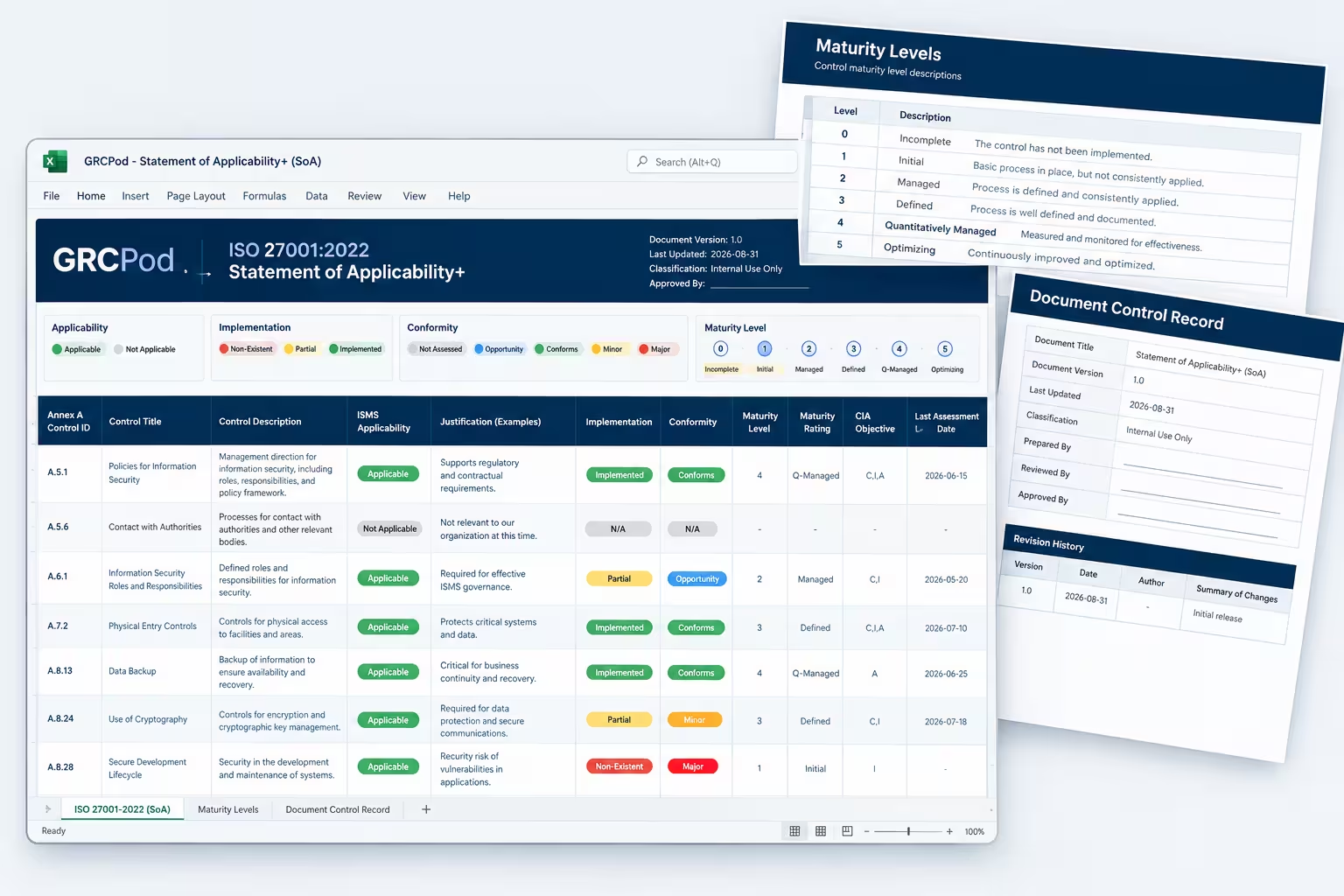
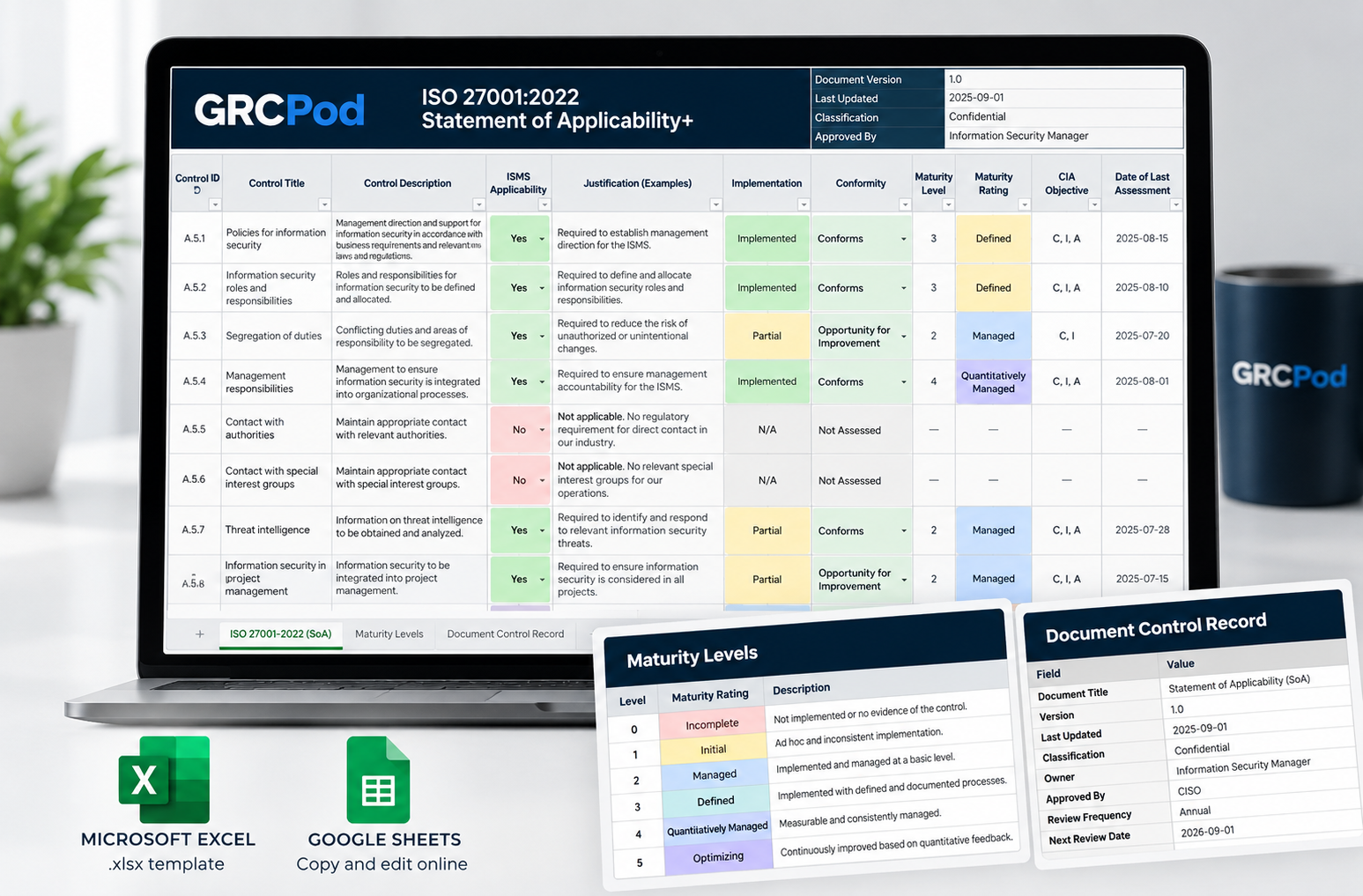
- Statement of Applicability;
- security policies;
- internal audit;
- corrective action;
- management review;
- implementation planning.
But templates still need organizational judgment.
A template doesn’t know your scope.
It doesn’t know your risks.
It doesn’t know your employees.
It doesn’t know your technology.
It doesn’t know which controls you need.
It doesn’t know how your processes actually operate.
The goal should be to use templates to accelerate the structure, then customize that structure around the real organization.
Where Organizations Waste Money on ISO 27001
ISO 27001 doesn’t have to become an enormous consulting and software project.
Several common mistakes can increase cost without creating equivalent value.
Buying Software Before Designing the Process
Organizations sometimes purchase a compliance platform before they understand how their ISMS should operate.
Define the process first.
Then determine whether software will improve it.
Outsourcing Every Decision
Consultants can provide valuable expertise.
But the organization ultimately has to operate the ISMS.
If every risk decision, policy, control, and process belongs to the consultant, the organization may struggle once the engagement ends.
Creating Unnecessary Documentation
More documentation does not automatically create a stronger ISMS.
Every document creates maintenance work.
Create what is necessary and useful.
Implementing Every Annex A Control Automatically
All 93 Annex A controls are not automatically mandatory.
Control decisions should be based on risk and requirements.
Our ISO 27001 Controls: A Practical Guide to Annex A explains this process.
Overengineering the ISMS
A smaller organization does not need to imitate the governance structure of a global enterprise.
The system should be appropriate to the organization.
Treating Certification as the Finish Line
Certification doesn’t eliminate ongoing costs.
The ISMS still needs to operate.
Audits continue.
Risks change.
Controls need monitoring.
Corrective actions need attention.
Policies and processes need maintenance.
Certification is a milestone in the lifecycle, not the end of it.
What Does ISO 27001 Cost After Certification?
The organization should expect ongoing costs after initial certification.
These can include:
- surveillance audits;
- eventual recertification;
- employee time;
- internal audits;
- management reviews;
- risk assessments;
- control operation;
- security awareness;
- corrective actions;
- policy maintenance;
- technology;
- security testing;
- supplier monitoring;
- improvement initiatives.
Some of those activities would likely exist even without ISO 27001.
That is worth considering when calculating cost.
For example, an organization should probably manage vulnerabilities, respond to incidents, control access, assess important suppliers, and maintain backups regardless of whether it pursues certification.
It may therefore be misleading to attribute the entire cost of those security activities to ISO 27001.
A better distinction is:
What would we already spend on responsible information security, and what incremental cost does ISO 27001 add?
That produces a more useful business case.
How to Reduce ISO 27001 Costs Without Cutting Corners
Cost control should focus on efficiency, not avoiding necessary security work.
Keep the Scope Purposeful
Define a scope that supports the business reason for certification.
Do not expand it unnecessarily.
Do not artificially shrink it in ways that make the scope misleading or ineffective.
Reuse Existing Processes
Don’t rebuild functioning processes merely to make them look like “ISO processes.”
If an existing change management process works, determine how it supports the ISMS.
The same applies to HR, supplier management, incident response, risk management, and other established activities.
Use Existing Evidence
If operational systems already generate reliable evidence, use it.
Avoid creating duplicate records solely for ISO 27001.
Use Templates as Accelerators
Templates can eliminate blank-page work.
Customize them rather than rebuilding common structures from scratch.
Fix the Biggest Gaps First
Not every improvement has equal importance.
Prioritize gaps based on risk, requirements, dependencies, and certification readiness.
Build the ISMS Into Normal Operations
The more ISO 27001 becomes part of everyday processes, the less effort is required to operate a separate “compliance system.”
That is usually better for both cost and sustainability.
Is ISO 27001 Certification Worth the Cost?
That depends on the business objective.
Certification can create significant value when it helps an organization:
- satisfy important customer requirements;
- qualify for procurement opportunities;
- support enterprise sales;
- demonstrate independent assurance;
- improve security governance;
- structure information security risk management;
- meet contractual expectations;
- reduce repeated customer assurance effort.
But certification should have a reason.
If leadership cannot explain why the organization is pursuing ISO 27001, the project can easily become an expensive compliance exercise.
A stronger business case connects certification to a concrete objective.
For example:
“Three strategic customers require ISO 27001 certification before expanding their contracts.”
That is much easier to evaluate financially than:
“ISO 27001 seems like something mature companies should have.”
ISO 27001 Cost Frequently Asked Questions
How much does ISO 27001 certification cost?
There is no universal price. Certification cost depends on factors such as organizational size, ISMS scope, complexity, locations, audit time, and the certification body. Total ISO 27001 cost can also include implementation, remediation, internal resources, consulting, training, software, and ongoing maintenance.
Is ISO 27001 expensive?
It can be, particularly for organizations with significant security or process gaps. Organizations with mature security practices and strong internal expertise may require substantially less implementation effort.
Do I need a consultant for ISO 27001?
No. Organizations can implement ISO 27001 internally. Consulting may be useful when the organization lacks expertise, needs additional capacity, wants independent assessment, or needs help accelerating the implementation.
Do I need GRC software?
No. ISO 27001 does not require a specific GRC platform. Organizations can use existing systems if those systems adequately support the ISMS.
Do I need to buy ISO 27001 templates?
No. Organizations can create their own documentation. Templates can reduce implementation time by providing a structured starting point.
Is the certification fee a one-time cost?
No. Maintaining certification involves ongoing certification activities, including surveillance audits and later recertification.
Does ISO 27001 require expensive security tools?
ISO 27001 does not prescribe a universal technology stack. The organization determines necessary controls based on its risks and requirements. Some organizations may need technology investments to address identified gaps.
Can a small business afford ISO 27001?
Potentially. A smaller organization may have a narrower scope and less complexity, but cost depends on its environment, current maturity, objectives, and the work required to establish the ISMS.
Calculate the Cost of Your Organization, Not Someone Else’s
There isn’t one meaningful answer to the question:
“What does ISO 27001 cost?”
A 50-person SaaS company with mature cloud security, one product, and experienced security staff is not implementing the same project as a multinational company with thousands of employees, legacy infrastructure, multiple offices, and dozens of business units.
The better approach is to build the estimate around your actual organization:
Scope → current maturity → gaps → implementation effort → remediation → certification → ongoing operation
That gives leadership a budget it can actually use.
And it highlights an important distinction.
The objective isn’t to spend the least possible amount on ISO 27001.
It is to avoid spending money on work that doesn’t improve the ISMS or help achieve the organization’s certification objective.
If you’re still determining what implementation involves, start with our ISO 27001 Implementation Guide: A Practical Roadmap for Building Your ISMS
If you’re approaching certification, our ISO 27001 Audit: What to Expect and How to Prepare explains what comes next.