
An ISO 27001 checklist can help you organize an implementation, but certification readiness is not achieved by simply checking off documents or implementing a list of security controls.
Before certification, your organization needs a functioning Information Security Management System (ISMS).
That means you should be able to demonstrate not only that the required elements of the ISMS have been established, but that important processes are operating, responsibilities are understood, controls are functioning, evidence exists, performance is being evaluated, and problems are being addressed.
A useful ISO 27001 checklist therefore needs to cover more than policies.
It should help you answer a more important question:
Can we demonstrate that our ISMS actually works?
This checklist walks through the major areas an organization should have addressed before pursuing ISO 27001 certification, from scope and risk assessment through controls, internal audit, management review, and certification readiness.
ISO 27001 Certification Readiness Checklist
Use this as a high-level implementation and readiness check.
| Area | Readiness Question |
|---|---|
| Business objective | Do we understand why we are implementing ISO 27001? |
| Context | Have we identified relevant internal and external issues? |
| Interested parties | Have relevant interested parties and requirements been identified? |
| Scope | Is the ISMS scope clearly defined and defensible? |
| Leadership | Is leadership involved and accountable? |
| Roles | Are ISMS responsibilities assigned and understood? |
| Information security policy | Has appropriate information security policy direction been established? |
| Risk methodology | Do we have a consistent risk assessment and treatment approach? |
| Risk assessment | Have information security risks been identified and evaluated? |
| Risk treatment | Have treatment decisions been made and approved? |
| Controls | Have necessary controls been determined and implemented? |
| Annex A comparison | Have necessary controls been compared with Annex A? |
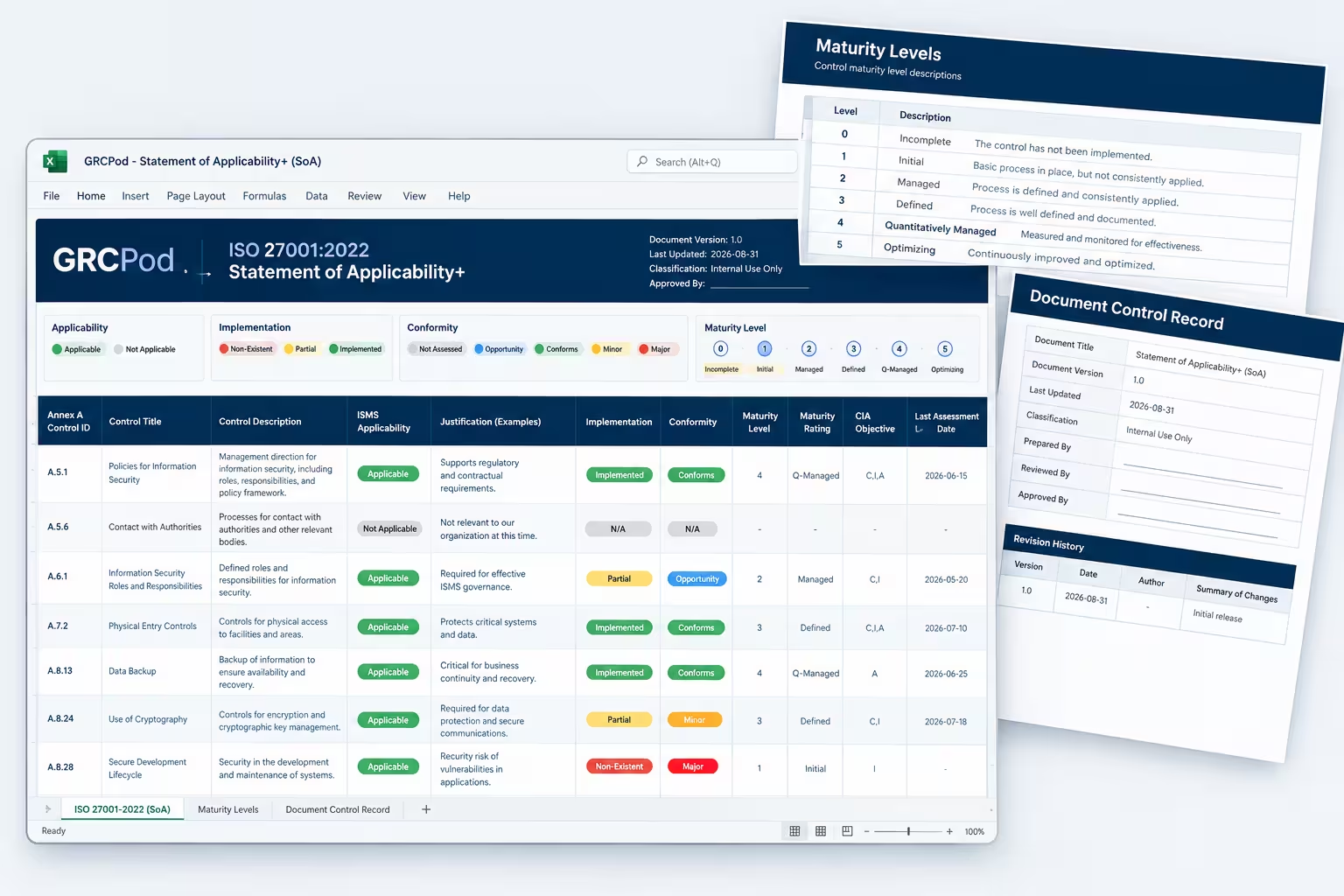
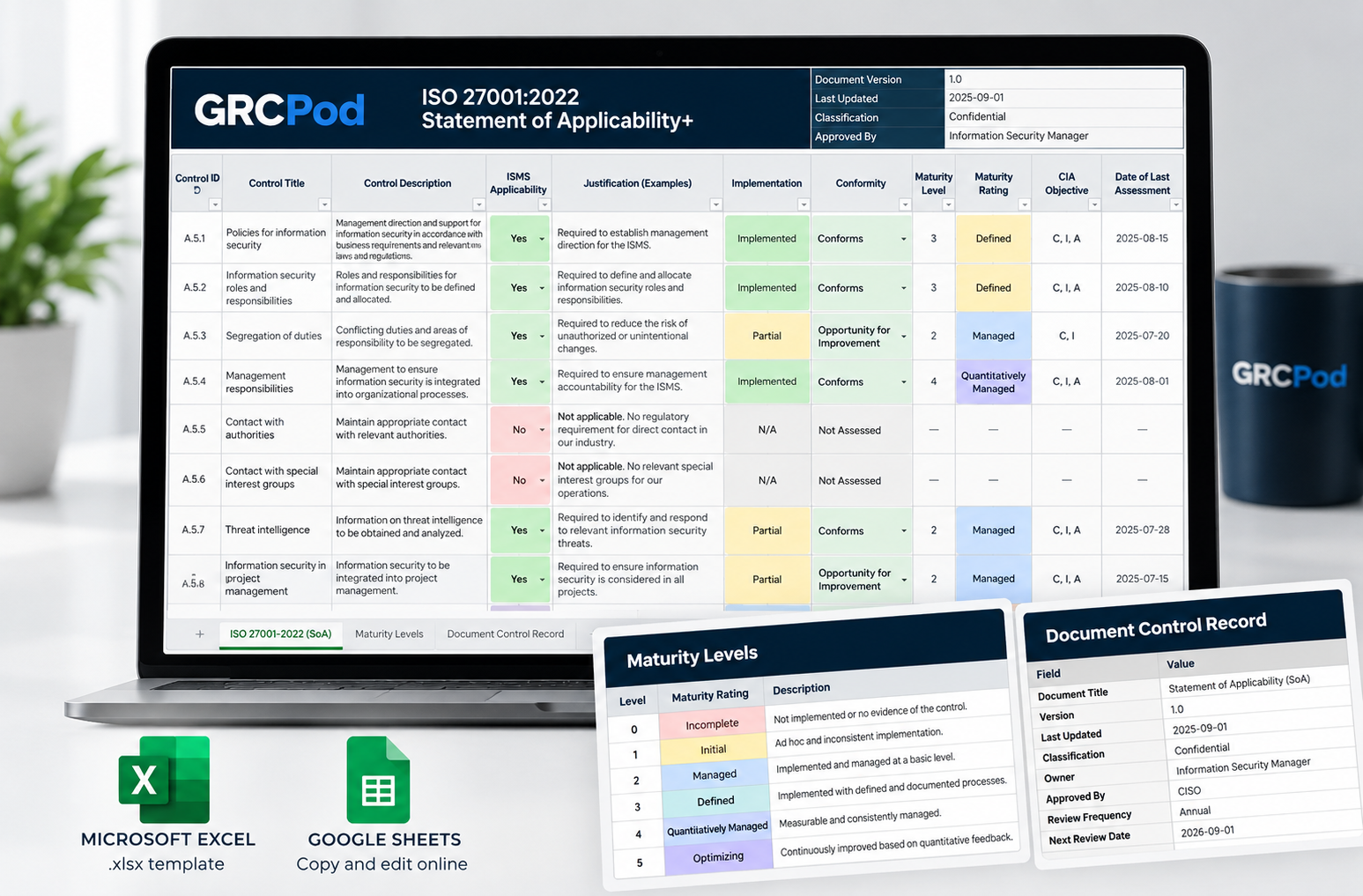
| Statement of Applicability | Is the SoA complete and aligned with actual control decisions? |
| Objectives | Have information security objectives been established and monitored? |
| Competence and awareness | Do relevant people understand their security responsibilities? |
| Documentation | Is necessary documented information established and controlled? |
| Operations | Are ISMS processes and controls actually operating? |
| Evidence | Can the organization demonstrate that important activities occurred? |
| Monitoring | Is ISMS performance being monitored and evaluated? |
| Internal audit | Has the ISMS been meaningfully audited internally? |
| Management review | Has management reviewed the ISMS and made necessary decisions? |
| Nonconformities | Are identified problems being addressed? |
| Corrective action | Are causes and corrective actions being managed appropriately? |
| Continual improvement | Can the organization demonstrate that the ISMS is improving? |
| Certification readiness | Can employees explain and demonstrate how the ISMS operates? |
If several of these questions produce uncertain answers, the organization may have more work to do before certification.
Let’s break each area down.
1. Define Why You Are Pursuing ISO 27001
Before building the ISMS, understand the business objective.
Organizations pursue ISO 27001 for different reasons.
You might be responding to:
- customer requirements;
- procurement requirements;
- contractual obligations;
- enterprise sales expectations;
- security improvement objectives;
- risk management needs;
- competitive pressure;
- board or leadership direction.
The reason matters because it affects scope, timing, resources, and certification decisions.
For example, if a major customer requires certification for a particular service, that business objective can help inform the appropriate ISMS scope.
If the organization is implementing ISO 27001 primarily to improve security governance, the project may be approached differently.
Checklist
- Business reason for ISO 27001 is understood.
- Leadership understands the intended outcome.
- Certification requirement has been confirmed if certification is the objective.
- Project ownership is established.
- Appropriate resources have been identified.
2. Understand the Organization and Its Context
An ISMS should reflect the organization it is designed to protect.
Before determining risks and controls, understand the environment in which the management system operates.
Consider relevant internal and external issues that could affect the ISMS and its intended outcomes.
Depending on the organization, these could involve:
- business strategy;
- organizational structure;
- technologies;
- customers;
- suppliers;
- regulatory environment;
- contractual requirements;
- workforce;
- geographic operations;
- market conditions;
- security threats;
- dependencies.
The objective is not to create an enormous environmental analysis.
It is to understand the factors that actually matter to the ISMS.
The current ISO 27001 requirements also require organizations to determine whether climate change is a relevant issue when considering organizational context.
Checklist
- Relevant internal issues have been identified.
- Relevant external issues have been identified.
- Climate change relevance has been considered.
- Context is reflected in ISMS planning.
- Significant changes to organizational context can be identified and addressed.
3. Identify Interested Parties and Their Requirements
Organizations do not manage information security in isolation.
Customers, regulators, employees, suppliers, business partners, owners, and other parties may have requirements relevant to the ISMS.
The organization should determine which interested parties are relevant and which of their requirements need to be addressed through the management system.
Examples might include:
- customer security requirements;
- contractual obligations;
- regulatory requirements;
- privacy obligations;
- supplier commitments;
- internal corporate requirements.
This work becomes important later because requirements can influence risk treatment and control decisions.
Checklist
- Relevant interested parties have been identified.
- Relevant requirements have been identified.
- Requirements are reviewed when circumstances change.
- Relevant requirements are considered in ISMS planning and operation.
4. Define the ISMS Scope
The ISMS scope establishes the boundaries of the management system.
It should clearly communicate what is covered.
Depending on the organization, scope may involve:
- business units;
- products or services;
- locations;
- processes;
- technologies;
- organizational functions;
- interfaces and dependencies.
Scope should support the organization’s business objective while accurately representing the environment being managed.
A narrow scope can be legitimate.
A misleading scope is not.
Dependencies also matter.
A system, supplier, or function outside the formal boundary may still affect something inside the scope. Drawing a boundary around the ISMS does not automatically eliminate those relationships.
Checklist
- ISMS boundaries have been determined.
- Relevant services, processes, locations, and organizational units are understood.
- Important interfaces and dependencies have been considered.
- Scope supports the business objective.
- Scope is documented.
- People involved in the ISMS understand what is in scope.
5. Establish Leadership and Accountability
ISO 27001 is a management system standard.
Leadership involvement is therefore more than approving the project budget.
Leadership needs to establish direction, support the ISMS, assign responsibilities, provide resources, and evaluate whether the management system is achieving its intended outcomes.
An ISMS owned entirely by one security or compliance employee is unlikely to operate effectively.
Checklist
- Leadership commitment can be demonstrated.
- Information security responsibilities are assigned.
- Appropriate resources are available.
- Information security is integrated into relevant business processes.
- Leadership receives meaningful information about ISMS performance.
- Accountability extends beyond the security or GRC team.
6. Establish the Information Security Policy
The information security policy provides high-level direction for the ISMS.
It should be appropriate to the organization and support its information security objectives.
But remember:
Having a policy is not evidence that the ISMS operates.
The policy establishes expectations.
Processes, controls, records, and behavior demonstrate whether those expectations are being carried out.
Checklist
- Appropriate information security policy direction has been established.
- The policy aligns with organizational context and objectives.
- Responsibilities for maintaining the policy are understood.
- The policy is appropriately communicated and available.
- Supporting practices are consistent with the policy.
7. Establish Your Risk Assessment Methodology
Before performing the risk assessment, determine how information security risk will be evaluated.
A consistent methodology helps prevent risk decisions from becoming arbitrary.
The methodology should establish how the organization approaches activities such as:
- identifying risks;
- identifying risk owners;
- analyzing likelihood;
- analyzing impact;
- determining risk levels;
- evaluating risk;
- establishing risk acceptance criteria;
- reassessing risk.
The methodology should fit the organization.
A small company does not necessarily need an elaborate quantitative risk model.
It does need a process that produces reasonably consistent and repeatable decisions.
Checklist
- Risk assessment methodology is established.
- Risk criteria are defined.
- Risk acceptance criteria are defined.
- Risk owners can be identified.
- Likelihood and impact approach is understood.
- The methodology can produce consistent and comparable results.
8. Complete the Information Security Risk Assessment
The risk assessment identifies and evaluates information security risks relevant to the ISMS.
Avoid reducing the exercise to vague entries such as:
Cyberattack: High
A useful risk statement gives decision-makers enough information to understand what could happen and why it matters.
For example:
Compromised privileged credentials could allow unauthorized access to production systems, resulting in customer data exposure and service disruption.
That scenario provides much more information for determining appropriate treatment.
Checklist
- Relevant information security risks have been identified.
- Risks are described clearly enough to support decisions.
- Likelihood and impact have been evaluated according to the methodology.
- Risk levels have been determined.
- Risk owners are identified.
- Risk evaluation criteria have been applied consistently.
- Results are documented.
Our upcoming ISO 27001 Risk Assessment: A Practical Guide will cover this process in detail.
9. Develop the Risk Treatment Plan
Once risks have been evaluated, determine what to do about them.
Risk treatment decisions may involve modifying risk through controls, avoiding activities creating the risk, sharing aspects of risk, or retaining risk when appropriate.
The important point is that treatment should follow risk analysis.
Controls should not be implemented merely because they appear on an ISO checklist.
Checklist
- Risks requiring treatment have been identified.
- Treatment decisions are documented.
- Necessary controls have been determined.
- Control owners are identified.
- Treatment responsibilities are assigned.
- Target dates are established where appropriate.
- Residual risk is considered.
- Appropriate risk acceptance or approval occurs.
10. Determine Necessary Controls
The organization should determine the controls necessary to implement its risk treatment decisions and address relevant requirements.
This is where organizations sometimes reverse the process.
The intended sequence is:
Requirements and risks → treatment decisions → necessary controls
not:
Annex A → implement 93 controls → search for justification
Controls may come from Annex A, another framework, contractual requirements, internal standards, or controls designed specifically by the organization.
Checklist
- Necessary controls have been determined from risk treatment and relevant requirements.
- Controls have defined objectives.
- Control ownership is clear.
- Control operation is understood.
- Evidence expectations are understood.
- Necessary controls have been compared with Annex A.
- Additional controls beyond Annex A are included where necessary.
For a deeper explanation, see ISO 27001 Controls: A Practical Guide to Annex A.
11. Complete the Statement of Applicability
The Statement of Applicability (SoA) connects the organization’s risk treatment decisions to its control environment.
The SoA should identify necessary controls, explain why they are included, indicate whether they have been implemented, and justify exclusions of Annex A reference controls.
It should reflect actual decisions.
A generic spreadsheet with 93 controls marked “Applicable” is not enough if the reasoning behind those decisions cannot be explained.
Checklist
- Necessary controls are represented.
- Control inclusion is justified.
- Implementation status is accurate.
- Annex A exclusions are justified.
- Additional necessary controls are represented appropriately.
- SoA aligns with risk treatment decisions.
- SoA aligns with actual control implementation.
We’ll cover this document separately in Statement of Applicability: A Practical ISO 27001 Guide.
12. Establish Information Security Objectives
The ISMS should have information security objectives that can be monitored.
Avoid objectives that sound good but cannot meaningfully be evaluated.
For example:
Improve cybersecurity
is difficult to manage.
An objective tied to a specific outcome, responsibility, measurement method, and timeframe provides much more value.
Objectives should help management determine whether the ISMS is moving toward intended results.
Checklist
- Information security objectives are established.
- Objectives align with information security policy direction.
- Relevant objectives can be measured or evaluated.
- Responsibilities are assigned.
- Progress is monitored.
- Results are reviewed.
- Actions are taken when objectives are not progressing as expected.
13. Establish Necessary Documentation
ISO 27001 requires documented information, but the goal is not to create the largest possible documentation library.
Documentation should support the management system.
Depending on the organization, important documented information may include items such as:
- ISMS scope;
- information security policy;
- risk assessment methodology;
- risk assessment results;
- risk treatment plan;
- Statement of Applicability;
- information security objectives;
- operating policies and procedures;
- monitoring records;
- internal audit records;
- management review records;
- corrective action records.
Additional documentation may be necessary based on the organization’s controls and processes.
Checklist
- Required documented information exists.
- Documents reflect actual organizational practices.
- Documents are appropriately reviewed and approved.
- Current versions are identifiable.
- Changes are controlled.
- Necessary records are retained.
- Obsolete documentation is appropriately managed.
14. Implement and Operate the Controls
This is where the ISMS moves from design into operation.
A documented control is not necessarily an operating control.
If the procedure says privileged access is reviewed quarterly, the organization should be able to demonstrate that those reviews actually occur.
If suppliers are supposed to receive security assessments, those assessments should exist.
If vulnerabilities are supposed to be remediated according to defined expectations, records should demonstrate what happened.
Checklist
- Control owners understand their responsibilities.
- Controls have actually been implemented.
- Controls operate at the expected frequency.
- Exceptions are handled.
- Failures are identified and addressed.
- Control changes are managed.
- Evidence is generated through normal operation.
15. Collect Operational Evidence
Evidence should not suddenly become important the week before an audit.
It should be a natural output of operating the ISMS.
Examples include:
| Process | Possible Evidence |
|---|---|
| Access management | Requests, approvals, access reviews |
| Security awareness | Training records and completion results |
| Vulnerability management | Scan results, remediation, exceptions |
| Supplier security | Assessments and risk decisions |
| Incident management | Incident records and corrective actions |
| Backups | Backup results and restoration testing |
| Change management | Requests, approvals, testing records |
| Risk management | Reviews and updated treatment decisions |
| Monitoring | Metrics, reports, and resulting actions |
Checklist
- Evidence exists for important control activities.
- Evidence can be retrieved efficiently.
- Records demonstrate actual operation.
- Evidence covers appropriate periods of operation.
- Exceptions and resulting actions are documented.
- Evidence retention practices are understood.
16. Monitor and Measure the ISMS
The organization needs information that helps determine whether the ISMS is performing as intended.
Do not measure everything simply because data exists.
Useful monitoring should help answer meaningful questions.
For example:
Are critical vulnerabilities being remediated?
Are security incidents increasing?
Are supplier assessments occurring when expected?
Are corrective actions remaining open too long?
Are access reviews identifying recurring problems?
Checklist
- Meaningful ISMS performance measures have been identified.
- Monitoring responsibilities are assigned.
- Results are reviewed.
- Trends and recurring problems can be identified.
- Monitoring produces useful management information.
- Results lead to action when necessary.
17. Complete the Internal Audit
Internal audit should evaluate the ISMS before certification.
This should not be a superficial exercise designed to produce a clean report.
A useful internal audit challenges the management system.
Auditors can examine records, interview process owners, sample evidence, compare practice with documented expectations, and trace risks to controls.
Finding legitimate problems internally is useful.
It gives the organization an opportunity to address them before the certification audit.
Checklist
- Internal audit program or approach has been established.
- Audit scope and criteria are defined.
- Auditor objectivity and impartiality are addressed.
- Auditor competence is appropriate.
- Relevant ISMS requirements and processes are evaluated.
- Evidence is sampled.
- Findings are documented.
- Results are communicated to appropriate management.
- Necessary corrective actions are initiated.
Our ISO 27001 Audit: What to Expect and How to Prepare explains internal and certification audits in more detail.
18. Complete Management Review
Management review is where leadership evaluates the ISMS.
It should not be treated as a ceremonial meeting scheduled solely because certification is approaching.
Management should receive enough information to make meaningful decisions about the system.
That can include information about:
- changes affecting the ISMS;
- security performance;
- objectives;
- audit results;
- risk;
- corrective actions;
- opportunities for improvement.
The value is in the decisions and actions that result.
Checklist
- Management review has occurred.
- Appropriate management participates.
- Required and relevant inputs are considered.
- ISMS performance is meaningfully discussed.
- Decisions are documented.
- Actions have owners where necessary.
- Follow-up can be demonstrated.
19. Address Nonconformities and Corrective Actions
If the internal audit, monitoring, incidents, or other activities identify problems, the organization should address them.
Do not try to create the appearance of an ISMS with zero problems.
A functioning management system identifies weaknesses.
The important question is whether the organization responds appropriately.
Corrective action should look beyond fixing the immediate symptom when a broader cause exists.
Checklist
- Nonconformities are recorded.
- Immediate correction occurs where appropriate.
- Causes are evaluated.
- Corrective actions are determined where necessary.
- Responsibilities and target dates are assigned.
- Actions are completed.
- Effectiveness is evaluated where appropriate.
- Recurring issues are identified.
20. Confirm Certification Readiness
Before the certification audit, step back from the documents.
Ask whether the organization can explain its own ISMS.
Can responsible people answer questions such as:
- What is the ISMS scope?
- What information security risks matter most?
- How are risks evaluated?
- How are controls selected?
- Who owns important controls?
- How do we know controls are operating?
- What did the last internal audit find?
- What did management decide during its last ISMS review?
- What has improved?
If those answers exist only inside documents that nobody understands, the ISMS may not be as mature as it appears.
Checklist
- Employees understand relevant ISMS responsibilities.
- Control owners can explain their controls.
- Risk owners understand important risks.
- Evidence can be retrieved.
- Documentation matches actual practices.
- Internal audit has challenged the system.
- Management review has occurred.
- Significant findings are being addressed.
- The organization can explain how risk connects to controls.
- The organization can demonstrate that the ISMS operates beyond audit preparation.
Documents You May Need for ISO 27001
There is no benefit in collecting random ISO 27001 templates simply because they appear on someone else’s checklist.
Your documentation should reflect the requirements and your actual ISMS.
Depending on the organization, the documentation set may include:
- ISMS scope and boundaries;
- information security policy;
- risk assessment methodology;
- risk register or risk assessment results;
- risk treatment plan;
- Statement of Applicability;
- information security objectives;
- roles and responsibilities;
- operational policies and procedures;
- internal audit plan and results;
- management review records;
- corrective action records;
- monitoring and measurement records;
- control-specific operational records.
Additional documentation may be necessary based on the controls and processes your organization has established.
The goal is not to produce documents.
The goal is to establish enough structure and evidence to operate the management system consistently.
What You Do Not Need Before ISO 27001 Certification
Just as important as knowing what you need is knowing what ISO 27001 does not automatically require.
- You Do Not Automatically Need All 93 Annex A Controls – Control selection should follow risk treatment and relevant requirements.
- You Do Not Need a Specific GRC Platform – ISO 27001 does not require specialized compliance software.
- You Do Not Need a Consultant – Organizations can implement ISO 27001 using internal resources when they have sufficient knowledge and capacity.
- You Do Not Need Hundreds of Policies – Documentation should support the ISMS, not create unnecessary bureaucracy.
- You Do Not Need a Perfect Internal Audit – Finding legitimate problems during internal audit is part of evaluating and improving the system.
- You Do Not Need to Eliminate All Information Security Risk – Risk management does not mean eliminating every possible risk.
The organization needs a consistent process for evaluating and treating risk according to its criteria and objectives.
Common ISO 27001 Checklist Mistakes
- Treating the Checklist as the Implementation: A checklist can organize work. It cannot make risk decisions, operate controls, assign accountability, or demonstrate effectiveness.
- Checking Off Documents That Nobody Uses: A completed policy means little if the process described in the policy doesn’t operate.
- Starting With Annex A: The 93 Annex A controls are not the starting point for the ISMS. Start with context, requirements, scope, and risk.
- Waiting Until the Audit to Look for Evidence: Evidence should accumulate through normal operation.
- Treating Internal Audit as a Formality: Internal audit is one of your best opportunities to identify problems before certification. Use it.
- Ignoring Small Inconsistencies: A single outdated document may not seem significant, but recurring differences between documented expectations and actual practices can indicate a larger management system problem.
- Making the GRC Team Responsible for Everything: The GRC or security team can coordinate the ISMS. It should not pretend to operate processes that actually belong to HR, IT, procurement, engineering, facilities, or business owners.
ISO 27001 Checklist Frequently Asked Questions
What do I need for ISO 27001 certification?
You need an implemented ISMS that meets applicable ISO 27001 requirements and can be evaluated through the certification process. This includes areas such as scope, risk assessment and treatment, controls, the Statement of Applicability, operational processes, monitoring, internal audit, management review, and continual improvement.
Do I need all 93 ISO 27001 controls?
No. Organizations determine necessary controls through risk treatment and relevant requirements, then compare those controls with Annex A to make sure necessary controls have not been omitted.
What documents are mandatory for ISO 27001?
ISO 27001 requires specific documented information and records, but the complete documentation set will also depend on the organization’s ISMS, processes, controls, and risks. Avoid assuming that every document included in a commercial template library is mandatory.
Do I need a Statement of Applicability?
Yes. The Statement of Applicability is an important part of the ISO 27001 risk treatment process and documents the organization’s necessary controls and relevant Annex A inclusion and exclusion decisions.
Do I need an internal audit before certification?
Internal audit is part of the ISO 27001 management system requirements and should be completed as part of evaluating the ISMS before initial certification.
Do I need management review before certification?
Management review is also part of the ISO 27001 management system requirements and should be performed as part of establishing and evaluating the ISMS.
How long should the ISMS operate before certification?
There is no single universal duration that applies to every organization. The important issue is whether the organization can demonstrate that its management system has been implemented and is operating sufficiently for meaningful evaluation.
Can I use an ISO 27001 checklist instead of a consultant?
A checklist can help organize implementation, but it does not replace the expertise needed to interpret requirements, make risk decisions, design controls, or evaluate whether the ISMS is ready for certification.
A Better Final Check Before Certification
Before calling your ISO 27001 implementation complete, don’t ask only:
“Have we checked every box?”
Ask:
Can we demonstrate the system?
Choose an important risk and follow it.
Risk → treatment decision → necessary control → control owner → operation → evidence → monitoring → improvement
Then choose an important process and follow that.
If your access control policy says access is reviewed periodically, find the most recent review.
Who performed it?
What systems were reviewed?
What problems were found?
What happened to those problems?
Then look at management oversight.
What did the internal audit identify?
What did management review?
What decisions resulted?
What has changed?
If those chains are clear, you are evaluating a management system rather than a collection of documents.
That is the level of readiness that matters.
If you’re still building your ISMS, use our ISO 27001 Implementation Guide: A Practical Roadmap for Building Your ISMS to work through the implementation sequence.
For control selection and Annex A, see ISO 27001 Controls: A Practical Guide to Annex A.
And before certification, review ISO 27001 Audit: What to Expect and How to Prepare.