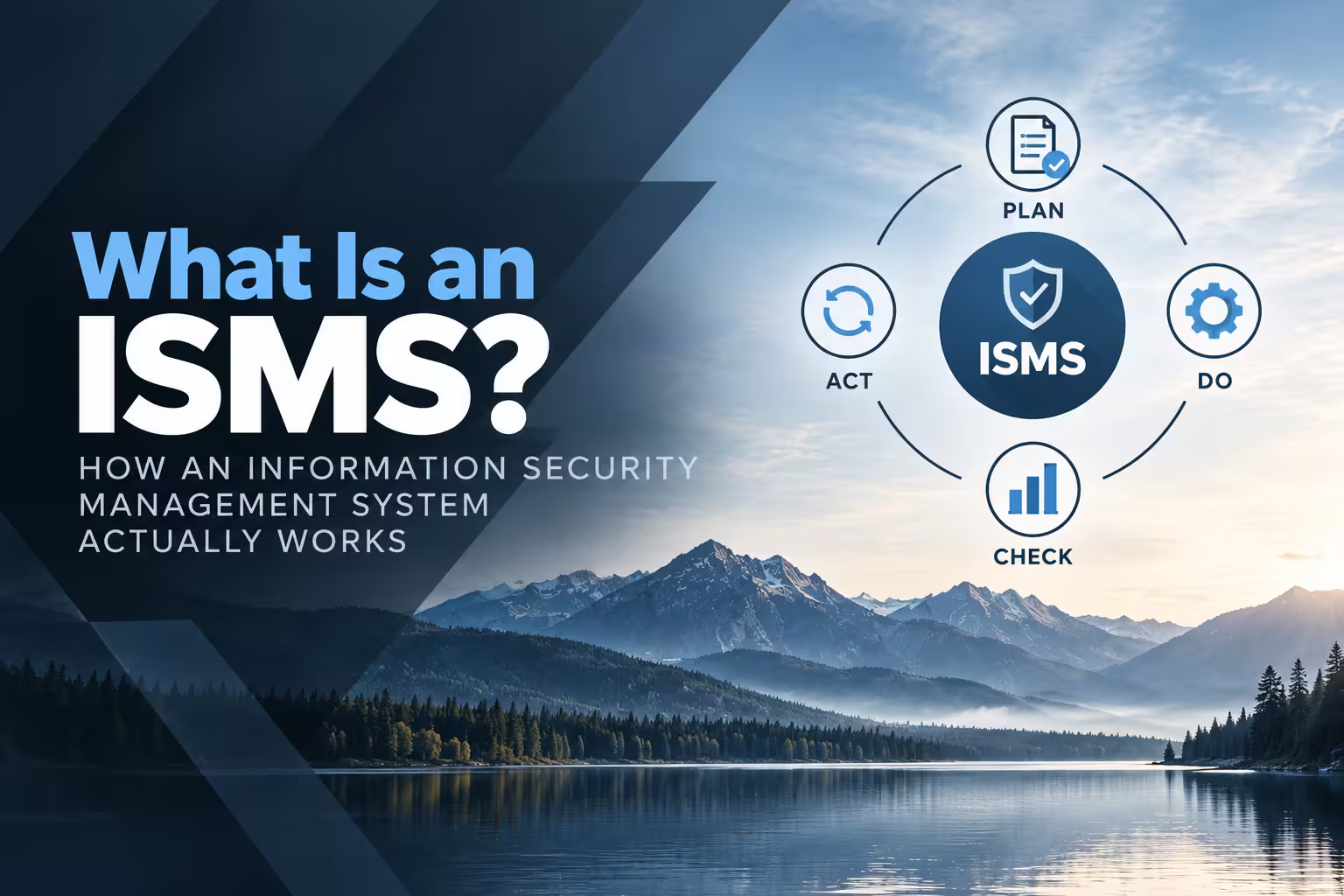
What Is an ISMS? How an Information Security Management System Actually Works
An Information Security Management System (ISMS) is the organized system an organization uses to manage information security risk.
It brings together the people, responsibilities, policies, processes, risk decisions, security controls, monitoring, evidence, and improvement activities needed to protect information in a consistent and repeatable way.
The word system is important.
An ISMS is not a folder of security policies. It is not a risk register. It is not a collection of cybersecurity tools. And it is not the 93 controls in ISO 27001 Annex A.
Those things can all be part of an ISMS.
But the ISMS is the management system connecting them.
A useful way to think about it is:
Business context → information security risks → treatment decisions → controls → ownership → operation → evidence → evaluation → improvement
When that cycle works, information security becomes an ongoing management process rather than a collection of disconnected security activities.
What Does ISMS Stand For?
ISMS stands for Information Security Management System.
Breaking the term into its three parts helps explain what it actually means.
Information Security refers to protecting information, particularly its confidentiality, integrity, and availability.
Management means the organization makes deliberate decisions about how information security will be governed, resourced, operated, measured, and improved.
System means those activities work together rather than functioning as isolated tasks.
That last part is where organizations sometimes struggle.
A company might already have firewalls, security awareness training, vendor assessments, access reviews, incident response procedures, and dozens of security policies.
Those activities do not automatically form an effective ISMS.
The organization also needs to understand why those activities exist, which risks they address, who owns them, how they are operated, how their performance is evaluated, and what happens when something doesn’t work as intended.
What Is the Purpose of an ISMS?
The purpose of an ISMS is to give an organization a structured way to manage information security risk.
That includes protecting the:
- Confidentiality of information by preventing unauthorized access or disclosure.
- Integrity of information by protecting its accuracy and completeness.
- Availability of information by making sure it and the systems supporting it are accessible when needed.
But an ISMS does more than establish those objectives.
It creates a repeatable process for managing them.
Without a management system, security decisions can become reactive.
A vulnerability appears, so the organization responds.
A customer sends a security questionnaire, so someone gathers evidence.
An audit approaches, so policies are reviewed.
A security incident occurs, so procedures are updated.
An employee leaves, so someone remembers to check their access.
An ISMS is intended to replace that kind of fragmented approach with a managed one.
The organization determines what matters, identifies risks, establishes controls, assigns accountability, operates those controls, evaluates the results, and makes changes when necessary.
How Does an ISMS Actually Work?
An ISMS works as a continuous management cycle.
The exact implementation varies between organizations, but a functioning ISMS generally connects several activities.
| ISMS Activity | What It Answers |
|---|---|
| Context and scope | What are we protecting, and where does the ISMS apply? |
| Governance | Who is responsible for what? |
| Risk assessment | What could affect the security of our information? |
| Risk treatment | What are we going to do about those risks? |
| Controls | What safeguards and processes are necessary? |
| Operation | Are those safeguards and processes actually happening? |
| Evidence | Can we demonstrate what happened? |
| Monitoring | Is the system performing as expected? |
| Internal audit | Are we conforming to requirements and our own arrangements? |
| Management review | Does leadership have enough information to evaluate the ISMS? |
| Corrective action | What do we do when something is wrong? |
| Continual improvement | How does the system get better over time? |
The value comes from the connections between these activities.
For example, suppose an organization identifies a risk that compromised privileged credentials could result in unauthorized access to sensitive production systems.
The organization decides to treat that risk using several controls, including multifactor authentication, restricted privileged accounts, logging, and periodic access reviews.
At that point, the ISMS shouldn’t stop at documenting those controls.
Someone needs to own them.
The controls need to operate.
Evidence needs to exist.
Exceptions need to be addressed.
Performance needs to be evaluated.
Changes to the risk need to be recognized.
If quarterly privileged access reviews repeatedly identify accounts that should have been removed months earlier, the question isn’t simply whether the review occurred.
The organization should also ask why inappropriate access persists and whether the underlying process needs improvement.
That feedback loop is what makes an ISMS a management system.
An ISMS Is More Than Documentation
Documentation is an important part of an ISMS, but documentation should not be confused with operation.
Consider an organization with an incident response policy.
The policy says security incidents must be identified, escalated, investigated, resolved, and reviewed.
That’s useful.
But what happens when an incident actually occurs?
A functioning ISMS should be able to demonstrate that the process operates in practice.
There might be:
- an incident record;
- severity classification;
- assigned responsibilities;
- investigation notes;
- escalation records;
- containment and recovery actions;
- decisions made during the incident;
- lessons learned;
- corrective actions;
- evidence that those corrective actions were completed.
The policy tells people what should happen.
The records demonstrate what did happen.
The same distinction applies throughout an ISMS.
| Document Says | Operating Evidence Might Show |
|---|---|
| Access is reviewed quarterly | Completed access reviews and resulting actions |
| Security awareness training is required | Training records and completion results |
| Suppliers are assessed | Completed assessments and risk decisions |
| Backups are monitored | Backup logs, failures, and remediation |
| Risks are reviewed | Updated assessments and treatment decisions |
| Vulnerabilities are managed | Scan results, prioritization, remediation, and exceptions |
| Incidents are investigated | Incident records and corrective actions |
A policy without operation is documentation.
Operation without evidence can be difficult to demonstrate or evaluate.
A mature ISMS connects all three:
Expectation → operation → evidence
What Are the Main Components of an ISMS?
There isn’t one universal organizational chart or software platform that defines an ISMS.
An effective ISMS is shaped by the organization using it.
However, several components usually need to work together.
Governance and Leadership
Someone has to be accountable for the ISMS.
Leadership establishes direction, provides resources, assigns responsibilities, and reviews whether the management system is achieving its intended outcomes.
Information security cannot function effectively as something the security team owns in isolation.
HR may own parts of employee lifecycle security.
Procurement may own portions of supplier onboarding.
IT may operate technical controls.
Business owners may make risk decisions.
Legal may identify contractual requirements.
Senior management may approve risk acceptance or determine priorities.
The ISMS connects those responsibilities.
Scope
The ISMS needs defined boundaries.
Scope determines which parts of the organization, services, processes, technologies, locations, and interfaces fall within the management system.
Poorly defined scope creates confusion about what the ISMS actually covers.
Scope also shouldn’t be treated as a way to make inconvenient dependencies disappear.
A system or supplier outside the formal boundary can still affect something inside the ISMS. Those interfaces and dependencies may still need to be understood and managed.
Risk Management
Risk management is one of the central mechanisms of an ISMS.
The organization establishes a consistent approach for identifying, analyzing, evaluating, and treating information security risks.
The objective is not merely to populate a risk register.
The process should help the organization make decisions.
What could happen?
Why could it happen?
What would the impact be?
How likely is the scenario?
Is the risk acceptable?
If not, what should be done about it?
Who owns the decision?
Those questions create the bridge between business risk and security activity.
Policies and Processes
Policies establish expectations and direction.
Supporting procedures and processes describe how activities are performed.
Depending on the organization, these might address areas such as:
- access control;
- incident management;
- supplier security;
- vulnerability management;
- asset management;
- acceptable use;
- change management;
- backups;
- secure development;
- business continuity;
- information classification.
The objective isn’t to create the largest possible policy library.
Documentation should support the operation of the ISMS.
Security Controls
Controls are measures used to modify information security risk or meet other relevant requirements.
Some are technical.
Others involve people, physical safeguards, or organizational processes.
A control could be multifactor authentication.
It could also be an employee screening process, a locked server room, a supplier security assessment, an access review, a contractual requirement, or an incident response process.
For organizations implementing ISO 27001, the controls determined to be necessary through risk treatment are compared against the reference controls in Annex A.
Our What Is ISO 27001? Requirements, Controls & Certification Explained guide explains how the standard and Annex A fit into the broader ISMS.
Roles and Responsibilities
Controls don’t operate themselves.
A functioning ISMS should make responsibility clear.
Who owns the risk?
Who operates the control?
Who reviews the evidence?
Who approves an exception?
Who investigates a failure?
Who decides whether residual risk is acceptable?
Ambiguous ownership is one of the easiest ways for a documented process to fail in practice.
Monitoring and Measurement
An organization needs ways to determine whether the ISMS is performing as intended.
That doesn’t mean measuring everything simply because it can be measured.
Useful monitoring should help answer meaningful questions.
For example:
Are critical vulnerabilities being remediated within expected timeframes?
Are security incidents increasing?
Are supplier assessments being completed before onboarding?
Are access reviews occurring as scheduled?
Are corrective actions remaining open beyond their target dates?
Are important controls repeatedly failing?
Metrics should support decisions, not simply fill dashboards.
Internal Audit
Internal audit provides a structured way to evaluate whether the ISMS conforms to applicable requirements and whether the organization’s own arrangements are being followed.
A useful internal audit goes beyond checking whether required documents exist.
It examines how the management system operates.
If a procedure says terminated users have their access removed promptly, an auditor can examine actual termination records and access removal evidence.
If supplier risk assessments are required, the auditor can sample suppliers and evaluate whether the process occurred.
That difference is important.
Policy is not evidence that a process operates effectively.
Management Review
Management review brings ISMS performance to leadership.
It gives management an opportunity to consider issues such as audit results, security performance, changing risks, interested-party needs, objectives, corrective actions, and opportunities for improvement.
This is not supposed to be a ceremonial annual meeting held only because ISO 27001 requires one.
A useful management review helps leadership answer:
Is our information security management system still appropriate, adequately supported, and producing the results we need?
Corrective Action and Improvement
Things will go wrong.
Controls will fail.
Audits will identify issues.
Processes will break down.
Risks will change.
An effective ISMS does not depend on pretending those problems don’t exist.
It needs a way to identify problems, understand why they occurred, correct them, and reduce the likelihood that they recur.
This is where continual improvement becomes practical rather than theoretical.
How ISO 27001 Relates to an ISMS
ISO 27001 and an ISMS are closely related, but they are not interchangeable terms.
The ISMS is the management system.
ISO 27001 is a standard that defines requirements for an ISMS.
An organization can establish information security management practices without pursuing ISO 27001 certification.
When an organization chooses to implement ISO 27001, however, the standard provides the requirements against which the ISMS can be designed and evaluated.
ISO 27001 organizes those management system requirements primarily through Clauses 4 through 10:
- Context of the organization
- Leadership
- Planning
- Support
- Operation
- Performance evaluation
- Improvement
Annex A then provides the reference set of 93 information security controls used as part of the ISO 27001 risk treatment process.
If you are planning to build an ISMS based on ISO 27001, our ISO 27001 Implementation Guide provides the complete implementation sequence.
What Does a Working ISMS Look Like?
One of the easiest ways to understand an ISMS is to compare a documentation-focused program with an operating management system.
| Documentation-Focused | Working ISMS |
|---|---|
| Risk register exists | Risks are reviewed and decisions change when circumstances change |
| Policies exist | Processes operate consistently with policy expectations |
| Control owners are listed | Owners understand and perform their responsibilities |
| Metrics are collected | Metrics inform decisions |
| Audit findings are recorded | Findings lead to corrective action |
| Management review occurs | Leadership evaluates performance and makes decisions |
| Training is assigned | Completion and effectiveness are evaluated |
| Supplier policy exists | Supplier risk is actually assessed and managed |
| Access review procedure exists | Reviews occur and inappropriate access is corrected |
The difference is not the number of documents.
It is whether the organization can demonstrate a functioning chain from expectations to actions to results.
The ISMS Feedback Loop
A useful way to evaluate an ISMS is to follow a decision all the way through the system.
Suppose the organization identifies a security risk.
Ask:
What decision was made about the risk?
Then:
What controls were established because of that decision?
Then:
Who owns those controls?
Then:
How do we know the controls are operating?
Then:
What evidence is produced?
Then:
How is performance evaluated?
Then:
What happens if the control fails or the risk changes?
A mature ISMS should be able to answer that entire chain.
That gives us a practical feedback loop:
Risk → treatment → control → ownership → operation → evidence → evaluation → improvement
This is a more useful test of ISMS maturity than simply counting policies or controls.
Who Is Responsible for the ISMS?
There is rarely one person who operates the entire ISMS.
An information security or GRC leader may coordinate the management system, but responsibilities typically extend across the organization.
For example:
| Function | Possible ISMS Responsibility |
|---|---|
| Executive leadership | Direction, resources, accountability, risk decisions |
| Information security | Security governance, risk, monitoring, technical oversight |
| IT | Technical operations and controls |
| HR | Employee lifecycle and awareness activities |
| Procurement | Supplier onboarding and contractual processes |
| Legal | Legal, regulatory, and contractual requirements |
| Business owners | Risk ownership and operational responsibilities |
| Internal audit | Independent evaluation |
| Employees | Following policies and reporting security concerns |
The exact allocation depends on the organization.
The important principle is that responsibilities are understood and accountability doesn’t disappear between functions.
An ISMS coordinated entirely by one security or compliance employee while the rest of the organization remains disconnected is unlikely to operate effectively.
Does an ISMS Require ISO 27001 Certification?
No.
An organization can establish an ISMS without pursuing ISO 27001 certification.
Certification becomes relevant when the organization wants an independent certification body to evaluate whether its ISMS conforms to ISO/IEC 27001 within a defined scope.
Organizations may pursue certification because of customer expectations, contractual requirements, competitive considerations, procurement requirements, or a desire for independent assurance.
Others may use ISO 27001 as the basis for their management system without seeking certification.
The decision should follow the organization’s business objectives.
Is an ISMS Only for Large Companies?
No.
An ISMS should be proportionate to the organization.
A smaller company may have fewer people, systems, suppliers, formal committees, and security processes than a global enterprise.
That does not mean it cannot operate an effective ISMS.
It means the management system should reflect its actual context.
A smaller organization might have one person performing several security responsibilities. A larger organization might distribute those responsibilities among specialized teams.
The underlying questions remain similar:
What information matters?
What could affect it?
What requirements apply?
What controls are necessary?
Who is responsible?
How do we know those controls are operating?
What happens when something changes?
Complexity should come from the needs of the organization, not from a belief that an ISMS has to be bureaucratic.
Common ISMS Mistakes
Treating the ISMS as a Documentation Project
Templates can accelerate implementation, but completing documents is not the same as establishing a management system.
Every important documented expectation should eventually connect to actual operation.
Starting With Controls Instead of Risk
Beginning with a control checklist can result in controls being implemented without a clear understanding of why they are needed.
Risk and requirements should help drive control decisions.
Giving the ISMS to One Person
Someone may coordinate the ISMS, but information security responsibilities usually cross multiple functions.
The management system needs organizational participation.
Creating Metrics Nobody Uses
A dashboard containing 40 security metrics is not necessarily better than one containing 8 useful metrics.
Measure what helps the organization understand performance and make decisions.
Preparing Only When an Audit Is Approaching
An ISMS that becomes active only before an audit is not functioning as a continuous management system.
Risk reviews, control activities, monitoring, corrective action, and management involvement should occur throughout the year.
Confusing a Policy With a Control
A policy can establish an expectation.
It does not prove the expected activity is happening.
If a policy says access is reviewed quarterly, the important question is whether access is actually reviewed quarterly and what happens when inappropriate access is discovered.
Ignoring Evidence Until Certification
Evidence should be a natural output of operating the system.
Trying to reconstruct months of evidence immediately before an audit creates unnecessary risk and often exposes processes that were documented but never consistently performed.
How Do You Build an ISMS?
Building an ISMS generally involves establishing the management system first, then operating and improving it.
A practical sequence is:
- Understand why the organization needs the ISMS.
- Understand organizational context and relevant requirements.
- Define the ISMS scope.
- Establish governance, roles, and responsibilities.
- Establish the risk management methodology.
- Identify and assess information security risks.
- Determine risk treatment.
- Determine necessary controls.
- Establish policies and supporting processes.
- Implement and operate the controls.
- Generate and retain appropriate evidence.
- Monitor and measure performance.
- Conduct internal audits.
- Perform management reviews.
- Address nonconformities and corrective actions.
- Continually improve the system.
If ISO 27001 is the framework you’re using, don’t try to build each of these pieces independently.
They should connect.
Our ISO 27001 Implementation Guide walks through this process step by step.
ISMS Frequently Asked Questions
What does ISMS mean?
ISMS stands for Information Security Management System. It is the management system an organization uses to manage information security risks in a structured and repeatable way.
Is an ISMS the same as ISO 27001?
No. An ISMS is the management system itself. ISO 27001 is an international standard that establishes requirements for an ISMS.
Is an ISMS a software platform?
No. Software can help manage parts of an ISMS, such as risks, controls, evidence, audits, policies, or corrective actions, but the software itself is not the ISMS.
Is an ISMS just a collection of policies?
No. Policies are one component. An ISMS also involves governance, risk management, controls, responsibilities, operation, evidence, monitoring, audits, management review, corrective action, and continual improvement.
Who owns an ISMS?
Ownership structures vary. Senior management has important responsibilities, while security, GRC, IT, HR, procurement, legal, business teams, and other functions may operate different parts of the management system.
Do small businesses need an ISMS?
An ISMS can be useful for organizations of different sizes. The structure and complexity should be proportionate to the organization’s risks, requirements, resources, and business context.
Do you need ISO 27001 certification to have an ISMS?
No. An organization can operate an ISMS without becoming ISO 27001 certified.
What is the difference between an ISMS and cybersecurity?
Cybersecurity activities can form part of an ISMS, but an ISMS is broader. It provides the management structure through which information security risks, including cybersecurity risks, are governed, treated, evaluated, and improved.
The Simplest Way to Think About an ISMS
An ISMS is not the documents.
It is not the security tools.
It is not the risk register.
It is not the audit.
It is not the Annex A controls.
Those are pieces of the system.
The ISMS is the mechanism that connects them.
A healthy ISMS creates a traceable chain:
Business context → risk → treatment → controls → owners → operation → evidence → evaluation → management decisions → improvement
If that chain exists and continues to operate, the organization has something much more valuable than a collection of compliance documents.
It has a management system.
If you’re building that system around ISO 27001, the next step is our ISO 27001 Implementation Guide: A Practical Roadmap for Building Your ISMS.